

5 Signs You Need a Brand Refresh
Has your business outgrown its brand? Five signs it's time for a refresh, and how to tell whether you need a refresh, a full rebrand, or a stronger system.

Most brands are born at a particular point in time. A founder with a clear idea, a tight budget, a first shop or a first few clients, and a strong sense of who the business is for. The identity that comes out of that moment usually fits it well.
Then the business keeps going. The team grows. The offering matures. The clients change, or the prices do, or a second location opens across town. And somewhere in all of that, the brand that once felt exactly right starts to feel a little unfamiliar. The logo still works. The colours are still recognizable. Nothing is actually broken. It just describes a version of the business that no longer leads.
That quiet distance is often the first sign you need a brand refresh, and it tends to show up as a feeling long before it becomes a problem. Here are five signs worth watching for, what they usually point to, and how to work out whether the next step is a refresh, a full rebrand, or simply a stronger system behind the identity you already have.
Before You Refresh Your Brand, Understand What Actually Needs to Change
Branding language gets used loosely, so a few working definitions help. Every studio draws the lines a little differently, but the distinctions underneath them matter.
Brand identity is the visual and verbal system that tells people who a business is: the logo, typeface, colours, imagery, layout, and tone of voice.
A brand refresh refines that identity. It keeps the recognition and goodwill the brand has already earned, and makes it more relevant, more consistent, or more expressive.
A rebrand goes further. It rethinks positioning, audience, and how the market sees the business. The identity follows from those decisions.
Brand maintenance is the work of running an established system well. It quietly solves far more inconsistency than most people expect.
A Change in Appearance Is Not Always a Change in Identity
When the thinking behind a brand is sound, new photography, clearer guidelines, or a fresh website can do much of the work. The size of the design response should match the size of the actual problem. That's why, at Saije, we start by understanding the whole brand before deciding which parts need attention.
Sign 1. Your Business Has Evolved, but Your Brand Still Reflects an Earlier Version of You
Growth Changes More Than the Size of Your Business
Growth rarely happens all at once. A business moves from entry-level work into something more specialized. A founder-led company becomes a team with its own processes and opinions. One restaurant becomes three. A consultancy that started with small projects is now trusted with much bigger ones.
Each of those shifts changes who the business is talking to and what it's promising them. The identity was designed for the earlier conversation.
Picture a boutique hotel that opened as a friendly, unpretentious place to stay. Five years in, the interiors have matured, the service has become more personal, and the rates reflect it. The brand still speaks in the language of that first year: friendly, casual, a little budget-minded. Nothing about it is poorly made. It's simply describing priorities the hotel has quietly moved past.
An evolving business doesn't automatically need a new identity. The current one may have room to stretch, and that's worth testing first. It's also why we design identity systems with a business's next stage in mind, and not only its launch.
Ask Yourself
If someone met our brand for the first time today, would they get an accurate impression of the company we've become?
Sign 2. Your Brand No Longer Communicates the Value of What You Offer
People Form Expectations Before They Experience Your Work
Long before anyone books a room, signs a proposal, or walks through the door, they've already formed a sense of what they're going to get. The typeface, the images, the pace of the layout, the way a sentence is written. Each detail hints at whether something is approachable or specialized, relaxed or exacting, new or established.
What matters is fit. The brand should match the value of the offering and the people it's for. For some businesses, that means more restraint. For others, it means more warmth and more personality.
When the Story You Tell and the Experience You Deliver Drift Apart
Think of a consultancy whose work is thoughtful, personal, and carefully considered. Its website is full of stock photos of handshakes, it describes itself the way every other consultancy does, and the style shifts from page to page. A prospective client has no way to see that level of care until they're already sitting across the table.
Branding is one of many influences on how people perceive value, and it won't settle a pricing conversation on its own. But when the brand undersells the work, the sales conversation ends up doing a job the brand should have started.
Sometimes the visual design is good and it's the positioning or messaging that needs work. A surface-level refresh would miss that entirely.
Ask Yourself
Does our brand help someone understand why our offering is worth choosing, or are we always explaining the difference ourselves?
Sign 3. Your Brand Feels Different Everywhere It Appears
Consistency Is About Familiarity
Most brands look their best in one place, usually the website or the launch deck. The real test is everywhere else.
You'll notice it in small moments. The sales deck uses a different font from the website. Instagram looks unrelated to the printed menu. Two departments have each built their own version of the brand, and neither is exactly wrong. Every new piece of collateral starts with the same question: what should this look like?
A brand can carry different moods in different places. A campaign can be louder than a proposal. What holds it together is a recognizable underlying system. Without one, flexibility slowly turns into fragmentation.
A Design System Should Make Everyday Decisions Easier
Guidelines, templates, image direction, type standards, reusable components. They're the unglamorous parts, and they're often where the real relief is. For a business with an in-house team producing new work every week, a clear system means fewer decisions made from scratch and more time spent on the work itself.
Inconsistency on its own rarely means the identity needs replacing. More often, the brand has never been documented in a way people can actually use.
Ask Yourself
Would someone recognize our business across all our touchpoints without seeing our logo?
Sign 4. Your Brand No Longer Feels Distinctive to the People You Want to Reach
Looking the Part Is Rarely Enough on Its Own
Every industry has its conventions, and they exist for a reason. They signal that you belong. Follow them too closely, though, and businesses start to blur together. Hospitality brands drift toward the same thin sans-serif and the same muted palette. Professional services firms describe themselves with the same few words. Lifestyle brands pick up whatever looked fresh last season.
There's nothing wrong with minimalism, a serif typeface, or a neutral palette. The trouble starts when visual choices lose their connection to the business's personality, positioning, or audience.
Distinction Begins With Knowing What Deserves to Be Recognized
A few questions worth sitting with:
• What feels different about working with us, or buying from us?
• What do customers mention without being prompted?
• What perspective, story, or values genuinely belong to us?
• Can anyone see that in the brand today?
Imagine two boutique hotels with similar aesthetics. One is built around privacy and quiet: deep seating, softly lit corridors, no one asking how your day was. The other is social and lively, with a shared breakfast table and talks in the lobby on Thursday nights. They sit in the same category. Their brands shouldn't make the same promise.
Distinctiveness has to be rooted in something the business can actually deliver. A striking identity attached to an ordinary experience creates its own kind of disconnect.
Ask Yourself
If we took our logo away, would our brand still feel recognizably ours?
Sign 5. You've Started Working Around Your Brand Instead of Working With It
The Small Compromises That Become Part of Everyday Work
This one rarely comes up in a brand audit. It turns up on a Tuesday afternoon, in a design file.
The logo gets left off certain formats because it doesn't reproduce well at small sizes. A campaign invents its own look because the guidelines leave no room for energy. Three versions of the logo sit in a shared folder, and nobody knows which one is current. A new service needs its own page, and there's no clear way to make it feel like part of the same family.
Each compromise is small and reasonable. Together, they describe a brand that has started creating more friction than clarity for the people who use it most.
Good Design Should Create Room for Growth
Not every application should be effortless. Brand work involves judgement. But a considered system should support the things a business does again and again: the weekly social post, the quarterly report, a new hire's first presentation, the opening of a second location. As a marketing team grows and produces more, the lack of clear standards gets harder to ignore.
A new identity is only one possible answer. Extending the current system, building better templates, or writing more complete guidelines can often solve the problem with far less disruption.
Ask Yourself
Is our brand helping us communicate more clearly, or are we constantly making up for what it can't do?
What If Your Brand Doesn't Need a Refresh After All?
Familiarity has a way of dulling things for the people closest to them. A founder who has looked at the same logo every day for six years may be tired of it long before a single customer is. The marketing team may want to try something new. A competitor may have just launched a beautiful website.
None of those, on their own, means a business needs a rebrand.
When Thoughtful Refinement May Be Enough
• Refreshing photography, imagery, or supporting graphics
• Strengthening brand guidelines and reusable templates
• Clarifying website messaging and the order information appears in
• Fixing inconsistent implementation across teams
• Building a coherent library of marketing assets
Sometimes the most valuable creative decision is knowing what to keep.
Brand Refresh or Full Rebrand? How to Decide What Comes Next
The right scale of change usually becomes clear once you've named the situation. Treat these as starting points rather than a formula.
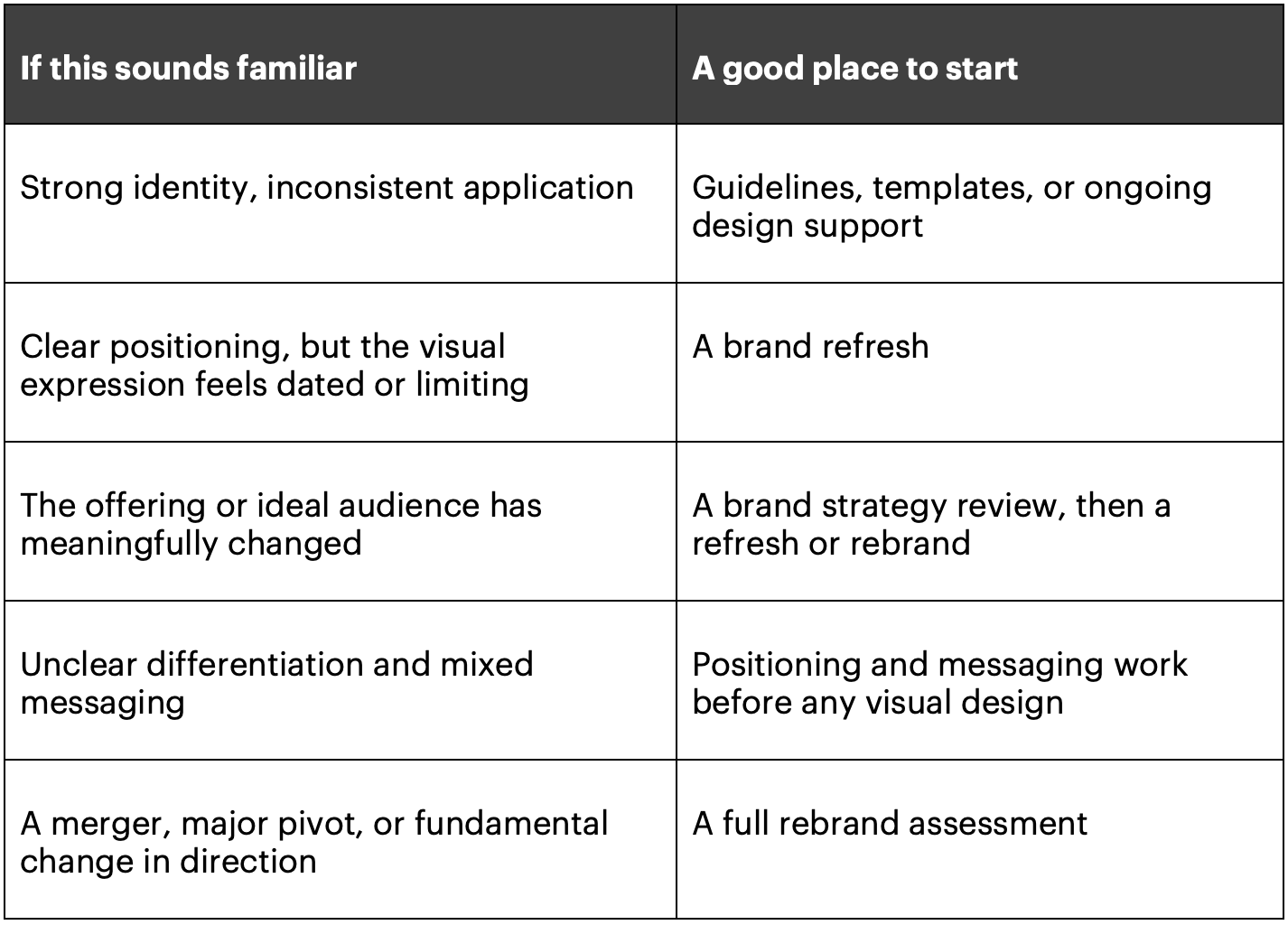
Three Questions Worth Answering Before You Begin
1. What has changed? The business, the audience, the offering, or the competitive landscape.
2. What's no longer working? Name the specific friction, whether it's in perception, communication, or the day-to-day.
3. What's still worth keeping? The parts customers recognize, trust, or feel connected to.
Good brand work starts with those conversations. The answers rarely point to a complete overhaul, and they almost always make the next decision easier to get right.
Frequently Asked Questions About Brand Refreshes
What's the difference between a brand refresh and a rebrand?
A brand refresh refines an existing identity while keeping the elements people already recognize. A rebrand rethinks more of the foundation: positioning, messaging, visual identity, and how the market sees the business. Which one you need comes down to what has actually changed, and what's still working.
How often should a company refresh its brand?
There's no set timetable. A brand is worth revisiting when something significant shifts in the business, the audience, the offering, or the competitive landscape, or when the current identity is creating friction you can point to. Age on its own isn't a reason to change.
Can you refresh your brand without changing your logo?
Yes. A refresh can touch typography, photography, colour, messaging, supporting graphics, the website, and brand guidelines while the logo stays exactly as it is. Strengthening the system around the mark often makes a bigger difference than replacing the mark itself.
How do you know if your brand is out of date?
Ask whether it still describes the business accurately, speaks to the right people, and works in every place it appears. Being unfashionable and being strategically out of date are different things. The better measure is whether the brand still supports where the business is heading.
What should you do before starting a brand refresh?
Start by naming what is and isn't working. Look at customer feedback, how the business has changed, input from your team, your current marketing materials, and your existing brand assets. Decide what you want to improve before thinking about visual changes, and be clear about what you're going to keep.
A Brand That Reflects Where You Are, With Room for Where You're Going
Businesses don't stand still, and the identities that represent them shouldn't have to either. A refresh doesn't ask a brand to leave its history behind. Done well, it keeps what still matters and makes room for what has changed.
The brands that last tend to be the ones that stay thoughtful about what they say, what they keep, and how they grow. How often they change matters far less.
When a business starts to feel different from its identity, that gap is worth a closer look. Often, nothing needs replacing. There's just more of the business waiting to be seen.
Does your brand still reflect the business you've become?
As businesses grow, their identities sometimes need more room to grow with them. At Saije Studio, we help brands bring more clarity, cohesion, and intention to how they present themselves. That might mean refining what's already there, or exploring a more meaningful change. If you're thinking about what's next for your brand, we'd love to hear what you're building.